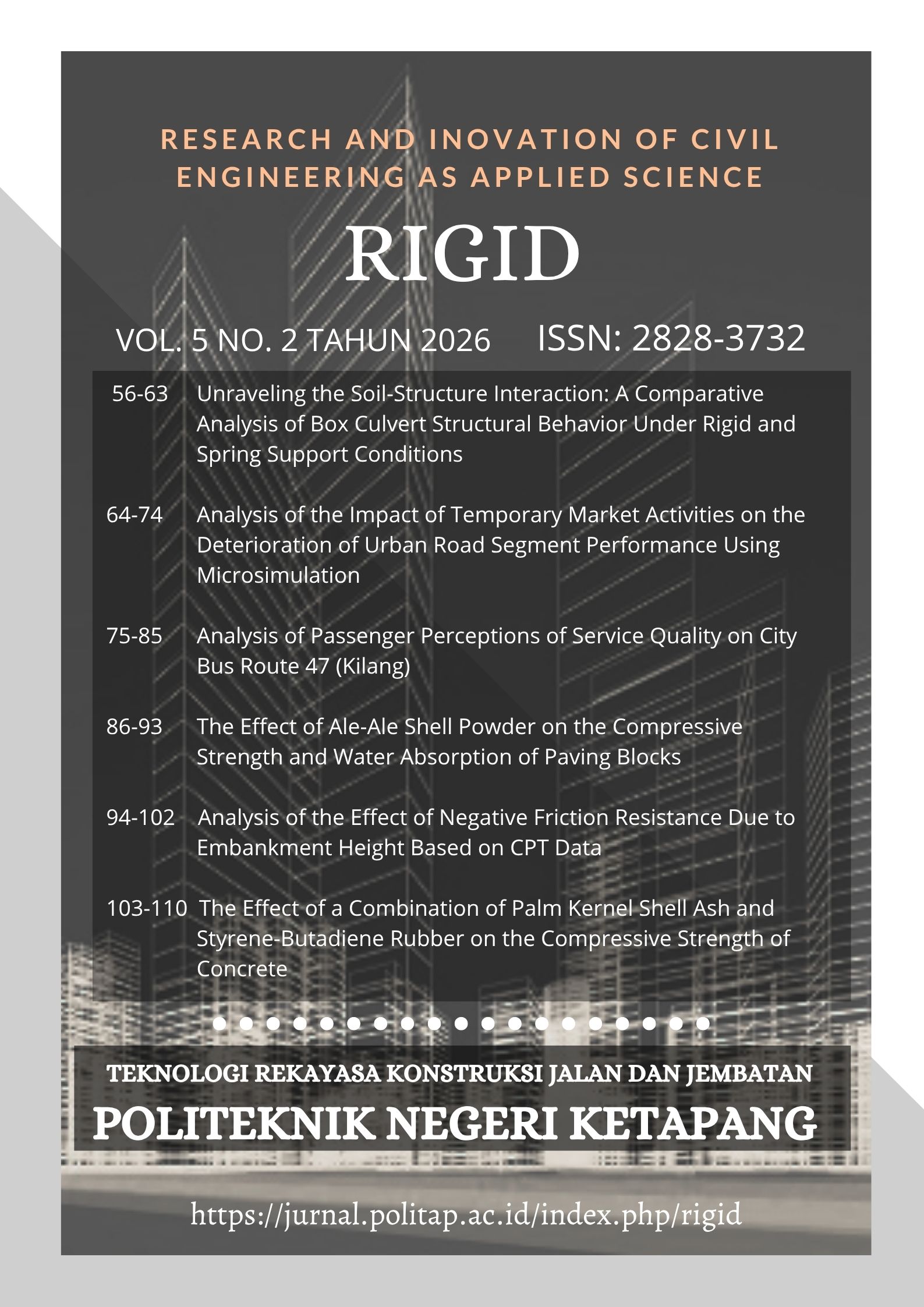
Analisis Dampak Aktivitas Pasar Temporer terhadap Degradasi Kinerja Ruas Jalan Perkotaan Menggunakan Mikrosimulasi
DOI:
https://doi.org/10.58466/cx4prh56Kata Kunci:
pasar temporer, hambatan samping, mikrosimulasi lalu lintas, Validasi GEH, degradasi kinerja ruasAbstrak
Aktivitas pasar temporer pada koridor perkotaan dapat menimbulkan hambatan samping yang berdampak langsung terhadap kinerja lalu lintas. Penelitian ini bertujuan menganalisis dampak aktivitas pasar temporer di sekitar Komplek Olahraga Bima Kota Cirebon terhadap kinerja ruas jalan menggunakan pendekatan mikrosimulasi. Model dibangun dengan perangkat lunak VISSIM berdasarkan data geometrik, volume lalu lintas, komposisi kendaraan, kecepatan, dan karakteristik hambatan samping pada dua kondisi, yaitu weekday atau hari normal dan weekend atau hari Minggu saat aktivitas pasar temporer berlangsung. Validasi model dilakukan menggunakan statistik GEH dengan membandingkan volume hasil simulasi dan observasi. Hasil validasi menunjukkan nilai GEH berada pada rentang 0,214–1,138, sehingga model dinyatakan layak untuk analisis perbandingan kinerja. Hasil penelitian menunjukkan bahwa total volume lalu lintas meningkat dari 3.148 kendaraan/jam pada kondisi normal menjadi 5.557 kendaraan/jam pada hari Minggu. Peningkatan volume tersebut diikuti oleh okupansi ruang tepi jalan akibat parkir, kendaraan berhenti sementara, aktivitas pedagang, dan pergerakan pejalan kaki. Kecepatan rata-rata dua arah menurun dari 27,91 km/jam menjadi 5,05 km/jam, sedangkan tundaan rata-rata meningkat dari 1,65 detik/kendaraan menjadi 94,48 detik/kendaraan. Tingkat pelayanan juga mengalami penurunan dari LOS A menjadi LOS F. Temuan ini menunjukkan bahwa degradasi kinerja ruas tidak hanya dipengaruhi oleh peningkatan volume, tetapi juga oleh meningkatnya hambatan samping dan berkurangnya lebar efektif jalan. Hasil penelitian dapat menjadi dasar awal untuk merumuskan manajemen lalu lintas temporer pada koridor perkotaan dengan aktivitas mingguan.
Referensi
[1] K. Srivastava and A. Kumar, “Critical Analysis of Road Side Friction on an Urban Arterial Road,” Engineering Technology & Applied Science Research, vol. 13, no. 2, pp. 10261–10269, 2023, doi: 10.48084/etasr.5603.
[2] A. Pratama, G. Kharisma, T. Setiawan, A. Rijaluddin, and M. Taufik, “Systematic Review of the Impact of Side Frictions on Road Service Levels in Urban Roadways,” Riggs Journal of Artificial Intelligence and Digital Business, vol. 4, no. 2, pp. 5355–5363, 2025, doi: 10.31004/riggs.v4i2.1337.
[3] P. Gulivindala and A. Mehar, “Analysis of Side Friction on Urban Arterials,” Transport and Telecommunication Journal, vol. 19, no. 1, pp. 21–30, 2018, doi: 10.2478/ttj-2018-0003.
[4] R. Musita, R. Anggraini, and S. Sugiarto, “The Analysis of Roadside Obstacles to the Performance of Syiah Kuala Street,” Iop Conference Series Materials Science and Engineering, vol. 933, no. 1, p. 12017, 2020, doi: 10.1088/1757-899x/933/1/012017.
[5] V. Mahardika, I. Irawati, and B. Tutuko, “Service Levels Analys in the Segment Street of Front Market Peterongan,” Ge-Stram Jurnal Perencanaan Dan Rekayasa Sipil, vol. 6, no. 2, pp. 84–91, 2023, doi: 10.25139/jprs.v6i2.6016.
[6] N. Padia, “Analisis Kinerja Lalu Lintas Pada Ruas Jalan Residen Ardiwinangun Kecamatan Mangkubumi Kota Tasikmalaya,” Miteks, vol. 2, no. 2, pp. 80–84, 2025, doi: 10.25157/mediailmiahtekniksipil.v2i2.3507.
[7] M. Rizal, M. Darwis, and N. Nagu, “Analysis of Road Capacity Due to Parking on Road Agency on the Jati Perumnas Segment of Ternate City,” Matec Web of Conferences, vol. 372, p. 7005, 2022, doi: 10.1051/matecconf/202237207005.
[8] M. Isradi, N. D. Nareswari, A. I. Rifai, A. Mufhidin, and J. Prasetijo, “Performance Analysis of Road Section and Unsignalized Intersections in Order to Prevent Traffic Jams on Jl H. Djole – Jl. Pasar Lama,” Adri International Journal of Civil Engineering, vol. 6, no. 1, pp. 56–67, 2022, doi: 10.29138/aijce.v6i1.21.
[9] N. A. Lestari, R. Rahman, and A. Tahir, “On Street Parking Effect to Performance of the Imam Bonjol Street in Palu City,” Journal of Applied Civil and Environmental Engineering, vol. 1, no. 1, p. 58, 2020, doi: 10.31963/jacee.v1i1.2647.
[10] M. S. Mahendra, A. Wicaksono, and L. Djakfar, “The Effect of Side Friction on Delays in One-Way Urban Road Sections,” Journal of Southwest Jiaotong University, vol. 56, no. 5, pp. 265–274, 2021, doi: 10.35741/issn.0258-2724.56.5.24.
[11] D. M. P. Wedagama, I. W. Suweda, and N. L. G. Astariyani, “The Influence of Side Friction on Speed-Mixed Flow Behavior on Arterial Roads in Tourism Area in Bali,” Civil Engineering and Architecture, vol. 10, no. 1, pp. 27–44, 2022, doi: 10.13189/cea.2022.100103.
[12] F. Rahman, R. Marleno, and H. Muhammadun, “Performance Analysis of Road Capacity for the Plan to Relocate on-Street Parking to Off-Street Parking (Case Study on Jalan Panglima Sudirman, Bojonegoro Regency),” Opsearch American Journal of Open Research, vol. 4, no. 1, pp. 398–410, 2025, doi: 10.58811/opsearch.v4i1.167.
[13] R. Sushmitha, S. Srikanth, and K. V. R. R. Shankar, “Impact of Side Friction on Saturation Flow at Signalized Intersections in Mixed Traffic Conditions,” U Porto Journal of Engineering, vol. 8, no. 6, pp. 90–101, 2022, doi: 10.24840/2183-6493_008.006_0007.
[14] L. Andrei and O. Luca, “Assessing the Transformative Potential: An Examination of the Urban Mobility Impact Based on an Open-Source Microscopic Traffic Simulator for Autonomous Vehicles,” Isprs International Journal of Geo-Information, vol. 13, no. 1, p. 16, 2024, doi: 10.3390/ijgi13010016.
[15] L. Gao et al., “A Micro-Simulation Framework for Studying CAVs Behavior and Control Utilizing a Traffic Simulator, Chassis Simulation, and a Shared Roadway Friction Database,” pp. 1650–1655, 2021, doi: 10.23919/acc50511.2021.9483221.
[16] A. Mandor, I. H. Hashim, I. El-Dessoky, and T. Abdel-Wahed, “Calibration and Validation of Microsimulation Models for Estimating Control Delay at Signalized Intersections in Upper Egypt, Sohag City as Case Study,” Sohag Engineering Journal, vol. 0, no. 0, p. 0, 2022, doi: 10.21608/sej.2022.157149.1020.
[17] F. O. Aryahito, R. Y. Wihardi, and M. A. Marunda, “Model Simulation of Holiday Session Traffic Flow at Three Ways Intersection in Indonesia,” vol. 4, no. 7, pp. 1323–1342, 2025.
[18] I. M. Pradana, S. Azalia, T. S. Muda, and M. Lestira, “Microsimulation-Based Traffic Management on Urban Roads in Indonesia,” Indonesian Journal of Advanced Research (IJAR), vol. 4, no. 7, pp. 1633–1652, 2025.
[19] M. Keyvan‐Ekbatani, R. C. Carlson, V. L. Knoop, and M. Papageorgiou, “Optimizing Distribution of Metered Traffic Flow in Perimeter Control: Queue and Delay Balancing Approaches,” Control Engineering Practice, vol. 110, p. 104762, 2021, doi: 10.1016/j.conengprac.2021.104762.
[20] M. K. Singh, N. Formosa, C. K. Man, C. Morton, C. B. Masera, and M. Quddus, “Assessing Temporary Traffic Management Measures on a Motorway: Lane Closures vs Narrow Lanes for Connected and Autonomous Vehicles in Roadworks,” Iet Intelligent Transport Systems, vol. 18, no. 7, pp. 1210–1226, 2024, doi: 10.1049/itr2.12503.
[21] J. Skovajsa, O. Přibyl, P. Přibyl, M. Ščerba, and A. Janota, “Evaluation of a Mobile Highway Management System at Roadwork Zones,” International Journal of Engineering, vol. 35, no. 5, pp. 900–907, 2022, doi: 10.5829/ije.2022.35.05b.06.
[22] D. Gunarathne, N. Amarasingha, A. Kulathunga, and V. Wicramasighe, “Optimization of VISSIM Driver Behavior Parameter Values Using Genetic Algorithm,” Periodica Polytechnica Transportation Engineering, vol. 51, no. 2, pp. 117–125, 2023, doi: 10.3311/pptr.20106.
[23] S. M. Hafram, S. Valery, and A. Hasim, “Calibrating and Validation Microscopic Traffic Simulation Models VISSIM for Enhanced Highway Capacity Planning,” International Journal of Engineering, vol. 36, no. 8, pp. 1509–1519, 2023, doi: 10.5829/ije.2023.36.08b.11.
[24] U. Hasan, H. A. Jassmi, and A. Hasan, “Microsimulation Modelling and Scenario Analysis of a Congested Abu Dhabi Highway,” Eng—advances in Engineering, vol. 4, no. 3, pp. 2003–2014, 2023, doi: 10.3390/eng4030113.
[25] I. Hoque, T. N. Ananda, P. Anowar, A. Naz, and M. Murshed, “Machine Learning Approach in Calibrating VISSIM Microsimulation Model for Mixed Traffic Conditions,” Journal of Engineering Science, vol. 16, no. 1, pp. 21–30, 2025, doi: 10.3329/jes.v16i1.82663.
[26] D. Espejel-García, J. A. Saniger-Alba, G. Wenglas-Lara, V. V Espejel-García, and A. Villalobos-Aragón, “A Comparison Among Manual and Automatic Calibration Methods in VISSIM in an Expressway (Chihuahua, Mexico),” Open Journal of Civil Engineering, vol. 07, no. 04, pp. 539–552, 2017, doi: 10.4236/ojce.2017.74036.
[27] T. Toledo and H. N. Koutsopoulos, “Statistical Validation of Traffic Simulation Models,” Transportation Research Record Journal of the Transportation Research Board, vol. 1876, no. 1, pp. 142–150, 2004, doi: 10.3141/1876-15.
[28] F. Tohom, I. D. Prasetyaningsih, and S. Hadi, “VISSIM-Based Assessment of Road Performance Under Proposed Bicycle Lane Scenarios: Case Study Adi Sumarno Road in Karangayar,” Biseeng, vol. 2, p. V225016, 2025, doi: 10.31603/biseeng.356.
[29] Z. A. Alkaissi and W. A. Kamoona, “Influence of Roadside Impedance on Speed and Capacity of Urban Streets,” Iop Conference Series Materials Science and Engineering, vol. 1090, no. 1, p. 12121, 2021, doi: 10.1088/1757-899x/1090/1/012121.
[30] B. Prasad, K. V Vidhyadhari, B. Sruthi, M. P. Kumar, and J. S. reddy, “Influence of Pedestrian Movement on Speed of Vehicles, Capacity and Level of Service of Urban Midblock Sections,” International Journal of Science and Research Archive, vol. 11, no. 2, pp. 2095–2103, 2024, doi: 10.30574/ijsra.2024.11.2.0663.
[31] B. Yulianto, S. Setiono, and F. Alissaditamtya, “Analisis Kinerja Simpang Bersinyal Nonongan Menggunakan Program Simulasi PTV VISSIM,” Matriks Teknik Sipil, vol. 11, no. 1, p. 81, 2023, doi: 10.20961/mateksi.v11i1.53318.
[32] I. Hoque, “Exploration of the Effects of Heterogenous Vehicle Composition on Urban Arterial Traffic Flow Attributes,” 2025, doi: 10.31224/4440.
[33] M. Bitangaza and H. Bwire, “Ffects of Roadside Friction Elements on Travel Performance and Level of Service in Kigali,” International Journal for Traffic and Transport Engineering, vol. 10, no. 2, pp. 236–251, 2020, doi: 10.7708/ijtte.2020.10(2).09.
[34] G. Suleiman, A. M. Dahamsheh, and M. Ergün, “Improvement of Highway Work Zone Performance by Traffic Management,” International Journal of Civil Engineering and Technology (Ijciet), vol. 11, no. 10, 2020, doi: 10.34218/ijciet.11.10.2020.003.