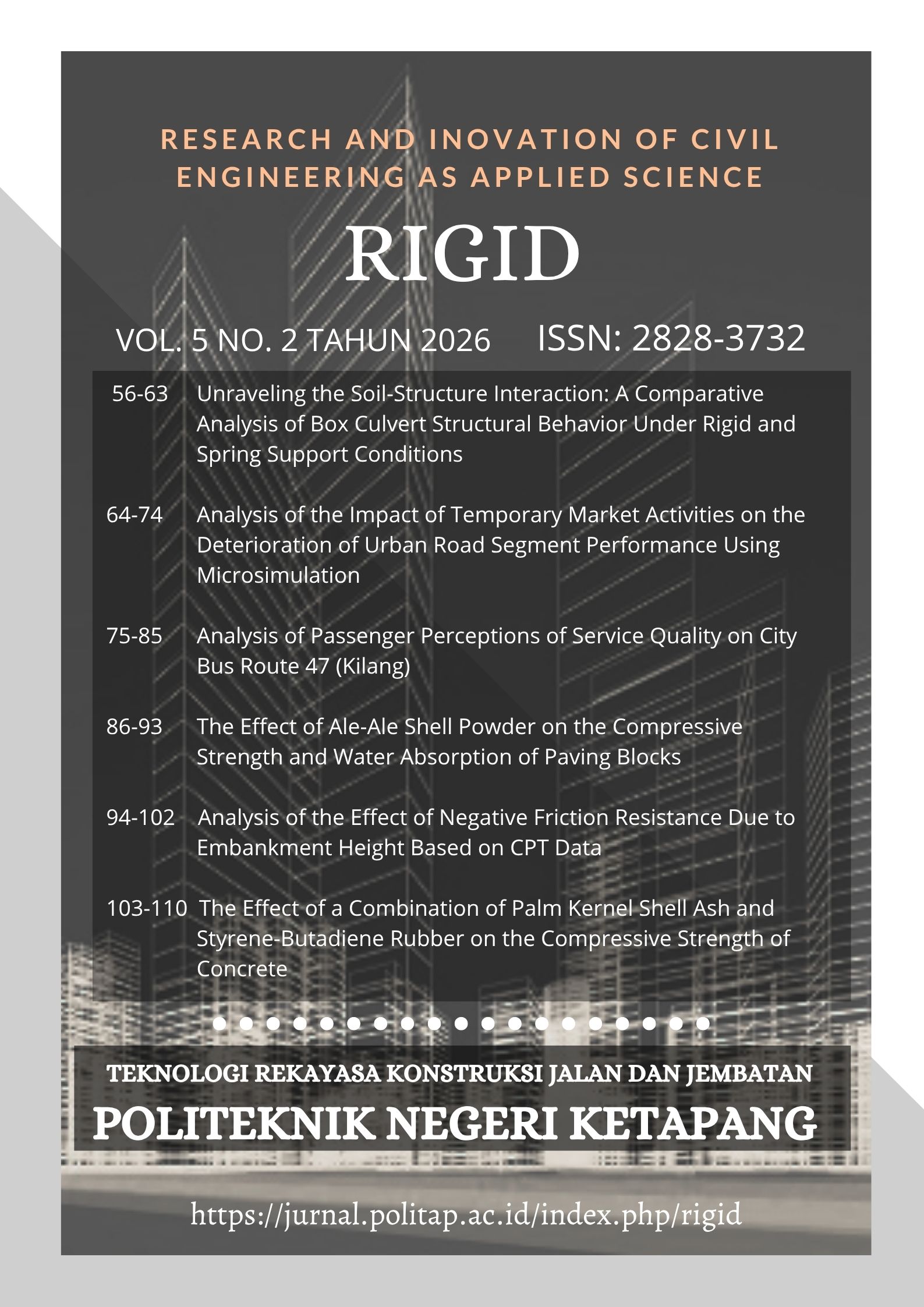
Unraveling the Soil-Structure Interaction: A Comparative Analysis of Box Culvert Structural Behavior Under Rigid and Spring Support Conditions
DOI:
https://doi.org/10.58466/gh8vdg82Keywords:
Box Culvert, Soil–Structure Interaction, Subgrade Reaction, Spring Support, Finite Element Analysis (FEA)Abstract
Box culverts are critical infrastructural elements routinely subjected to complex soil-structure interaction phenomena. The conventional approach of assuming rigid foundation supports often leads to an unrealistic distribution of internal forces, potentially resulting in overly conservative or dangerously unconservative designs. This study investigates the structural behavior of a reinforced concrete box culvert by comparing a fully rigid support model against subgrade reaction models utilizing spring placements. Specifically, the analysis evaluates the variations in maximum bending moment (Mmax), axial force (Pmax), maximum shear force (Vmax), and deflection (Δ) across the top slab, vertical walls, and bottom slab. The spring models are further dissected into three configurations: springs without rigid links, springs with 4 rigid links, and springs with 8 rigid links. The findings reveal that the transition from rigid to spring supports fundamentally alters the load distribution, significantly reducing bottom slab axial forces from 135.94 kN to 0.00 kN in extreme cases, while modifying shear and moment profiles across the structure. The inclusion of rigid links demonstrates a stabilizing effect, closely mimicking realistic soil restraint while preventing localized stress concentrations. This research provides critical insights for engineers seeking to optimize box culvert designs by accurately modeling subgrade reaction.
References
[1] AASHTO. (2014). AASHTO LRFD Bridge Design Specifications.
[2] Abuhajar, O., El Naggar, H., & Newson, T. (2015). Experimental and numerical investigations of the effect of soil backfill on the seismic response of buried box culverts. Soil Dynamics and Earthquake Engineering, 79, 130–148.
[3] ACI Committee 318. (2019a). Building Code Requirements for Structural Concrete (ACI 318-19) and Commentary. American Concrete Institute.
[4] ACI Committee 318. (2019b). Building Code Requirements for Structural Concrete (ACI 318-19) and Commentary (ACI 318R-19). American Concrete Institute.
[5] Aco Wahyudi Efendi, Senot Sangadji, Halwan Afisa Saifullah, & Stefanus Kristiawan. (2024). Behavior of Fastener Due to Tensile Loads on Cold Rolled Steel with LISA V.8 FEA. Lecture Notes in Civil Engineering-Conference: International Conference on Rehabilitation and Maintenance in Civil Engineering, 1, 379–390.
[6] American Association of State Highway, & Officials, T. (2020). AASHTO LRFD Bridge Design Specifications (9th ed.). American Association of State Highway and Transportation Officials.
[7] Audebert, M., & Thibeau, S. (2021). Numerical analysis of soil-structure interaction in buried box culverts. Journal of Geotechnical and Geoenvironmental Engineering, 147(3), 4021005.
[8] Bathe, K. J. (1996). Finite Element Procedures. Prentice Hall.
[9] Bennett, R. M., Wood, L. D., Drumm, E. C., & Rainwater, N. R. (2005). Vertical loads on concrete box culverts under high embankments. Journal of Bridge Engineering, 10(6), 643–649.
[10] Bowles, J. E. (1996). Foundation Analysis and Design (5th ed.). McGraw-Hill.
[11] Burd, H. J., & Yu, H. S. (2021). Modelling the soil-structure interaction of buried structures. Geotechnique, 71(9), 775–791.
[12] Coduto, D. P. (2001). Foundation Design: Principles and Practices (2nd ed.). Prentice Hall.
[13] Cook, R. D., Malkus, D. S., Plesha, M. E., & Witt, R. J. (2001). Concepts and Applications of Finite Element Analysis (4th ed.). John Wiley & Sons.
[14] Das, B. M. (2019). Principles of Foundation Engineering (9th ed.). Cengage Learning.
[15] Efendi, A. W. (2024a). APPLICATION OF CHATGPT IN THE ANALYSIS OF INTERNAL FORCES OCCURRING IN SIMPLE BEAMS USING LISA V. 8 FEA. Selodang Mayang: Jurnal Ilmiah Badan …. https://ojs.selodangmayang.com/index.php/bappeda/article/view/313
[16] Efendi, A. W. (2024b). ChatGPT application in ground settlement analysis using LISA V. 8 FEA. Research of Scientia Naturalis. https://journal.ypidathu.or.id/index.php/scientia/article/view/826
[17] Efendi, I. A. W., & Eng, A. (2024a). Structural Performance and Stress Contour Analysis of Multi Utility Tunnels Using LISA V. 8 Finite Element Analysis. Journal of Research and Inovation in Civil …. https://jurnal.politap.ac.id/index.php/rigid/article/view/1589
[18] Efendi, I. A. W., & Eng, A. (2024b). Structural Performance and Stress Contour Analysis of Multi Utility Tunnels Using LISA V. 8 Finite Element Analysis. Journal of Research and Inovation in Civil …. https://jurnal.politap.ac.id/index.php/rigid/article/view/1589
[19] Elgamal, A. (2020). Soil-structure interaction in flexible buried structures. International Journal of Geomechanics, 20(8), 4020132.
[20] European Committee for Standardization. (2004). Eurocode 2: Design of Concrete Structures - Part 1-1: General Rules and Rules for Buildings. European Committee for Standardization.
[21] Fang, H. Y. (1991). Foundation Engineering Handbook (2nd ed.). Van Nostrand Reinhold.
[22] Fédération internationale du béton. (2013). Model Code for Concrete Structures 2010. Fédération internationale du béton.
[23] Fredlund, D. G., & Rahardjo, H. (1993). Soil Mechanics for Unsaturated Soils. John Wiley & Sons.
[24] Galvão, A. S., Silva, W. P., & Mendes, P. T. C. (2018). On the modeling of soil-structure interaction using rigid links and spring elements. Structural Engineering and Mechanics, 66(4), 489–500.
[25] Greco, V. A. (2010). Analytical solution of beams on elastic foundations using Winkler models. International Journal of Geotechnical Engineering, 4(3), 375–384.
[26] Holtz, R. D., Kovacs, W. D., & Sheahan, T. C. (2011). An Introduction to Geotechnical Engineering (2nd ed.). Pearson.
[27] Horvath, J. S. (1983). Modelling of soil-structure interaction: A structural engineer’s perspective. Journal of the Structural Division, 109(6), 1234–1245.
[28] Kang, J., Parker, F., & Yoo, C. H. (2008). Soil-structure interaction for buried box culverts: A numerical investigation. Computers and Geotechnics, 35(3), 392–401.
[29] Krishna, P. L., & Rajasekhar, D. K. (2018). Analysis and design of box culvert. … Journal of Science Technology and …. https://www.academia.edu/download/57645036/IJSTEV4I10070.pdf
[30] Lambe, T. W., & Whitman, R. V. (1969). Soil Mechanics. John Wiley & Sons.
[31] Logan, D. L. (2011). A First Course in the Finite Element Method (5th ed.). Cengage Learning.
[32] McAfee, R. P., & Valsangkar, A. J. (2004). Geotechnical properties of compressible materials used for induced trench construction. Journal of Testing and Evaluation, 32(2), 143–152.
[33] McGrath, T. J., Liepins, A. A., & Smith, J. L. (2004). Behavior of Reinforced Concrete Box Culverts Under Deep Burial. Transportation Research Board.
[34] Moore, I. D. (2001). Buried pipes and culverts. In Geotechnical and Geoenvironmental Engineering Handbook (pp. 541–563).
[35] Selvadurai, A. P. S. (1979). Elastic Analysis of Soil-Foundation Interaction. Elsevier Scientific Publishing Company.
[36] Teodoroski, B. D., & Tschuchnigg, F. (2023). Advanced finite element modeling of soil-structure interaction: The role of interface elements. Acta Geotechnica, 18(2), 801–816.
[37] Terzaghi, K. (1955). Evaluation of coefficients of subgrade reaction. Geotechnique, 5(4), 297–326.
[38] Wilson, E. L., & Habibullah, A. (1987). SAP90: A Series of Computer Programs for the Static and Dynamic Finite Element Analysis of Structures. Computers and Structures Inc.
[39] Winkler, E. (1867). Die Lehre von der Elastizität und Festigkeit. Dominicus.
[40] Zienkiewicz, O. C., & Taylor, R. L. (2005). The Finite Element Method for Solid and Structural Mechanics (6th ed.). Butterworth-Heinemann.