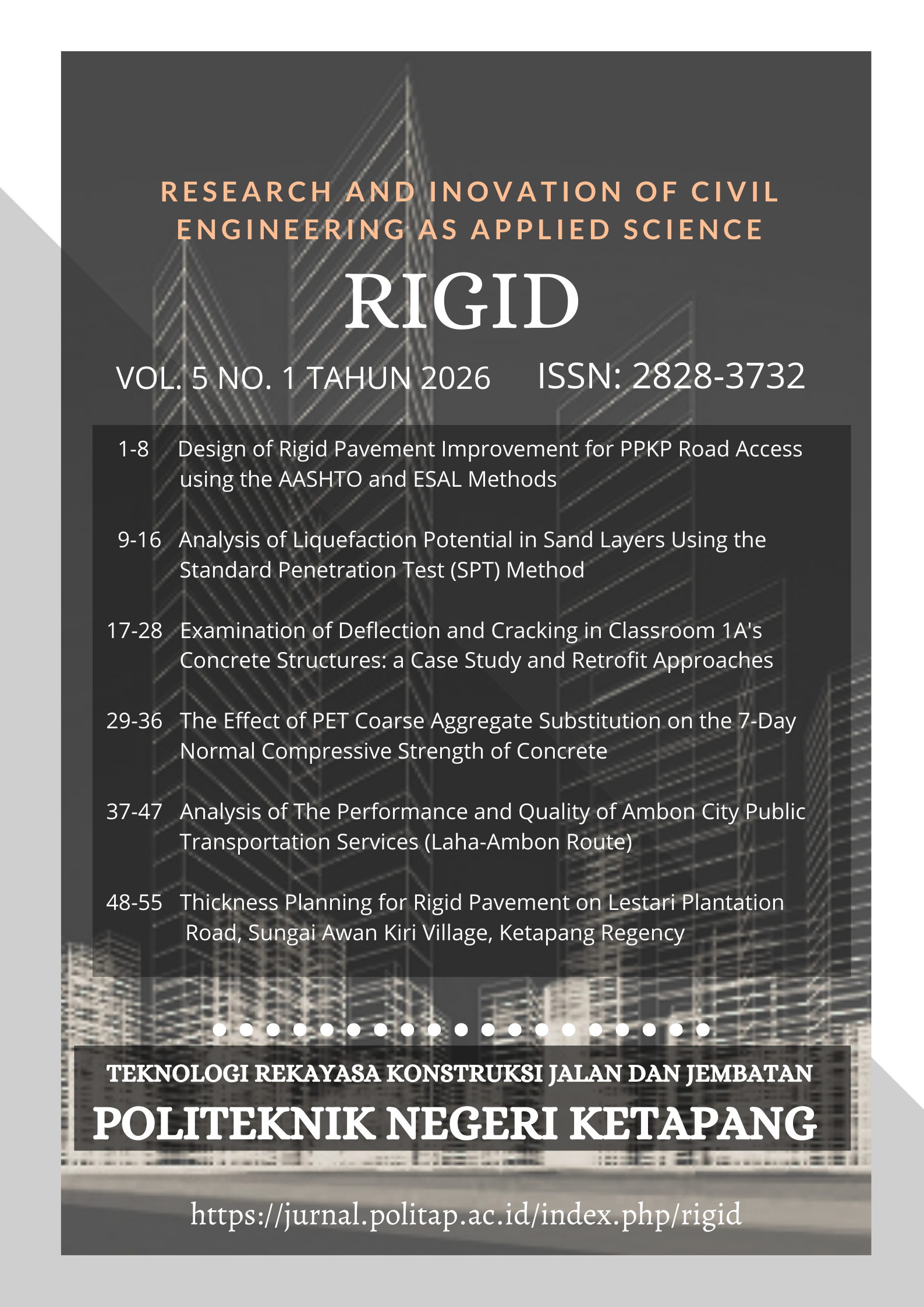
Analysis of The Performance and Quality of Ambon City Public Transportation Services (Laha-Ambon Route)
DOI:
https://doi.org/10.58466/190b1s26Keywords:
Ambon City Public Transportation, Laha-Ambon Route, Land Transportation Performance Standards, Importance Performance Analysis (IPA) MethodAbstract
This study is titled "Performance and Quality Analysis of Public Transportation Services in Ambon City (Laha-Ambon Route)", aiming to evaluate the performance and service quality of public transportation on the Laha-Ambon route and analyze the relationship between technical performance and service quality based on user perceptions. The research employs a quantitative descriptive approach with primary data collected through dynamic surveys, static surveys, and interviews with 100 users. Service performance is measured using seven main indicators according to the Directorate General of Land Transportation standards: load factor, frequency, fleet availability, travel speed, headway, service time, and travel time. Service quality is analyzed using the Importance Performance Analysis (IPA) method based on 20 attributes covering comfort, accessibility, reliability, and safety. The results indicate that the performance of the public transportation service on the Laha route falls into the "moderate" category with a total score of 12, while the quality of service from users’ perceptions is considered "good" with a suitability level of 67.01%. Correlation analysis shows a strong positive relationship between technical performance and service quality (r=0.653; p < 0.05). Although some technical indicators are not yet optimal, user satisfaction remains high due to directly experienced service factors such as ease of boarding and alighting, security, and polite driver behavior. The study recommends improvements on the less optimal performance indicators, adjustments of operational standards to be more adaptive to user needs, and continuous communication enhancement with users to improve service quality.
References
[1] Warpani PS. Merencanakan Sistem Perangkutan. Bandung: ITB; 1990.
[2] Tamin OZ, Frazila RB. Penerapan konsep interaksi tata guna lahan-sistem transportasi dalam perencanaan sistem jaringan transportasi. Jurnal Perencanaan Wilayah dan Kota. 1997;8(3):11-18.
[3] Abubakar I, Yani A, Sutiono E. Menuju lalu lintas dan angkutan jalan yang tertib. Jakarta: PT Bukit Mayana; 1997.
[4] Binovan FI, Simangunsong JE, Rahman T. Evaluasi kinerja operasional dan pelayanan pada angkutan kota (angkot) trayek F Kota Samarinda. Jurnal Ilmu Pengetahuan dan Teknologi Sipil. 2022;[tahun/tidak ada volume]:[halaman].
[5] Hanum S, Susanti A. Evaluasi kinerja pelayanan angkutan umum pedesaan di Kabupaten Bangkalan (Rute: Kamal–Tanah Merah–Blega–Lomaer). Jurnal Media Publikasi Terapan Transportasi. 2024;2(1):[halaman].
[6] Keputusan Menteri Perhubungan Nomor KM 35 Tahun 2003 tentang Penyelenggaraan Angkutan Orang di Jalan dengan Kendaraan Umum. Jakarta: Direktorat Jenderal Perhubungan Darat; 2003.
[7] Mukhoyyaroh NI, Agustyawan PE. Pelayanan transportasi umum Surabaya Raya dengan metode customer satisfaction index dan importance performance analysis. JURMATEKS: Jurnal Manajemen Teknologi dan Teknik Sipil. 2022;[volume(issue)]:[halaman].
[8] Mulyadi, Adawiyah R. Analisis kinerja pelayanan angkutan umum Kota Banjarmasin, Provinsi Kalimantan Selatan. Jurnal Kacapuri: Jurnal Keilmuan Teknik Sipil. 2023;6(2):324.
[9] Mulyono T. Studi literatur evaluasi kualitas pelayanan angkutan umum oleh pengguna. WARTA ARDHIA. 2024;49(1):1.
[10] Murtejo T, Muhajir A, Alimuddin A, Chayati N. Evaluasi kinerja angkutan umum Trans Pakuan trayek Terminal Bubulak via Cidangiang–Ciawi di Kota Bogor. Jurnal Komposit. 2023;7(1):61-68.
[11] Peraturan Pemerintah Republik Indonesia Nomor 41 Tahun 1993 tentang Angkutan Jalan. Jakarta: Departemen Perhubungan Darat; 1993.
[12] Peraturan Pemerintah Republik Indonesia Nomor 74 Tahun 2014 tentang Angkutan Jalan. Jakarta: Departemen Perhubungan Darat; 2014.
[13] Purnomo RA, Nugroho RA, Yorika R. Evaluasi kinerja pelayanan angkutan umum Kota Samarinda (studi kasus trayek B). Ruang. 2022;8(1):119-129.
[14] Putri CT, Umam K, Hudaya A. Pengaruh kualitas pelayanan terhadap kepuasan penumpang Bus Transjakarta di Halte Busway PGC 2 Koridor X (PGC 2–Tanjung Priok). Economics Learning Experience & Social Thinking Education Journal. 2024;4(1):56-65.
[15] Shbeeb L. The relation between transit service availability and productivity with customers satisfaction. Transportation Research Interdisciplinary Perspectives. 2022;16:[halaman].
[16] Siburian T, Rahmat H, Waniyati. Evaluasi kinerja dan tingkat kepuasan pengguna moda transportasi Trans Metro Pekanbaru rute Ramayana–Pandau Permai. [Jurnal/Tidak lengkap]. 2023;3(Oktober):41-56.
[17] Surat Keputusan Direktur Jenderal Perhubungan Darat Nomor SK 687/Aj.206/DRDJ/2002 tentang Pedoman Teknis Penyelenggaraan Angkutan Penumpang Umum di Wilayah Perkotaan dalam Trayek Tetap dan Teratur. Jakarta: Departemen Perhubungan; 2002.
[18] Vuchic VR. Urban Transit Systems and Technology. Hoboken: John Wiley & Sons; 2007Tamin, O. Z., & Frazila, R. B. (1997). Penerapan Konsep Interaksi Tata Guna Lahan-Sistem Transportasi Dalam Perencanaan Sistem Jaringan Transportasi. Jurnal Perencanaan Wilayah dan Kata, 8(3), 11-18.